For Virginia towns, counties, school divisions, and special districts
Accessibility readiness for Virginia public websites.
Virginia's amended IT Access Act applies to localities under 50,000 and their school divisions beginning April 26, 2027, a year before the federal ADA Title II web rule reaches them. It has applied to larger localities and their school divisions since April 24, 2026. We inventory everything you publish, audit it by hand against WCAG 2.1 AA, and give you a dated, documented plan your board and your vendors can act on.
The dates that matter
Virginia's IT Access Act, as amended in 2025, applies on a date set by population, and a school division takes the date of the locality it sits in. The federal rule sets WCAG 2.1 Level AA for state and local government web content and mobile apps (28 CFR 35.200), and the state law points to it.
-
Since April 24, 2026
Localities of 50,000 or more and their school divisions: Virginia's amended IT Access Act applies. It calls for a published accessibility contact and barrier-report procedure, technology that conforms with the federal rule's accessibility requirements (28 CFR 35.200), and accessibility terms in IT contracts negotiated or renewed from that date.
-
April 26, 2027
Localities under 50,000, their school divisions, and special districts: the same state law applies. Public entities of 50,000 or more: the federal ADA Title II web rule applies.
-
April 26, 2028
Public entities under 50,000 and special districts: the federal ADA Title II web rule applies.
Virginia's dates did not change when the Department of Justice delayed the federal dates in April 2026. Because the state law points to the federal rule, ask your attorney how that delay bears on what the state law requires. A lawsuit in federal court in Maryland, National Federation of the Blind v. Department of Justice, asks the court to set the delay aside. It was pending as of October 2026. If it succeeds, the federal dates could return to the original April 24, 2026 and April 26, 2027, the same as the state dates.
Your website vendor covers part of it
Most website plans scan the pages inside your content management system. The federal rule, which the state law points to, covers everything you publish, including the systems around it.
-
PDFs
Agendas, minutes, budgets, forms, and notices, often thousands of files.
-
Payment portals
Tax, utility, permit, and court payments run by third parties.
-
GIS and maps
Parcel viewers, zoning maps, and service-area lookups.
-
Agenda and meeting systems
Board packets, video archives, and public-comment tools.
-
Utility billing and permits
Customer portals and online applications.
-
Mobile apps
Apps you offer to residents, families, or students.
What you get
Start with the packet. Keep the evidence file running through your state and federal dates, and after them.
Readiness packet
$2,500 to $4,500
One time, scoped by the number of sites and systems you run.
- Inventory of every web property and third-party app
- Your accessibility contact, barrier-report procedure, and accessibility statement, ready to post
- Vendor contract terms checklist and review of conformance reports (ACRs and VPATs)
- PDF triage against the archived-content exception
- Manual audit of 15 to 25 page templates
- Remediation plan with specific asks for each vendor
- A memo ready for your board or council
Evidence file
$99 to $149/month
Monthly, after the packet.
- Monthly scans of every web property
- Running log of PDFs and what was fixed
- A dated progress record you can point to if your accessibility work is ever questioned
The first proposal shows the year-one picture on one quote: the packet, ongoing monitoring and typical fixes.
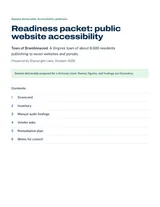 See a sample readiness packet Prepared for a fictional Virginia town: inventory, audit findings, vendor asks, a dated plan, and a council memo.
Start with a free 10-page sample audit.
We'll audit 10 pages of your site and send a scorecard: who runs your website, your state and federal dates, whether your IT Access Act contact and an accessibility statement are posted, how many PDFs you publish, and how many issues an automated scan finds.
Common questions
Our website vendor says we are covered. Are we?
Probably not completely. Most vendor plans scan the pages inside their content management system. The federal rule, which the state law points to, also covers PDFs, third-party portals for payments, GIS, agendas, and billing, and any apps you offer. We inventory all of it and tell you exactly what to ask each vendor for.
We have fewer than 50,000 residents. Isn't our deadline April 2028?
Only for the federal rule. Virginia's amended IT Access Act applies to localities under 50,000, and to their school divisions, a year earlier, beginning April 26, 2027. From then, the state law calls for a published accessibility contact with a procedure for barrier reports, accessibility terms in IT contracts you negotiate or renew, and technology that conforms with the federal rule's accessibility requirements. How the federal delay bears on that last duty is a question for your attorney. Starting now puts the contact, the contract terms, and your most-used pages and forms ahead of that date, and a dated plan is the record you'll want if your progress is ever questioned.
Can automated scanning do this for us?
Scanners are useful, and the evidence file includes them, but they catch only part of the problems. Keyboard traps, confusing form labels, unreadable PDFs, and broken screen reader flows need a person to test them. That is why the packet includes a manual audit of your page templates.
Do you fix the problems too?
Yes. Fix work (PDF remediation, form rebuilds, staff training, retests) is quoted on the same proposal as the packet, as line items.
How do we buy this?
We send one written quote covering the full scope for your procurement file; your purchasing officer decides how it is bought.
Is this legal advice?
No. We are technologists, not attorneys. We give you an inventory, an audit against WCAG 2.1 AA, and a documented plan. Talk to your county or town attorney about legal questions, including how the state and federal dates apply to you.
Shipwright Labs provides technical accessibility audits and documentation, not legal advice. References: DOJ ADA Title II web and mobile rule, 28 CFR 35.200, as amended by the interim final rule of April 20, 2026 (91 FR 20902); Virginia Information Technology Access Act, Va. Code 2.2-3500 through 2.2-3505, as amended by HB2541 (2025 Acts ch. 571), with its dates in the third, fourth, and fifth enactment clauses; National Federation of the Blind v. Department of Justice, No. 1:26-cv-02007 (D. Md., filed May 21, 2026).